
 ご利用方法について
 車種について
 観光ガイド
 よくあるご質問
 お問い合わせ
Where to Park in Naha: Parking Fees, Hotels and a Day Without the Car
2026.11.28
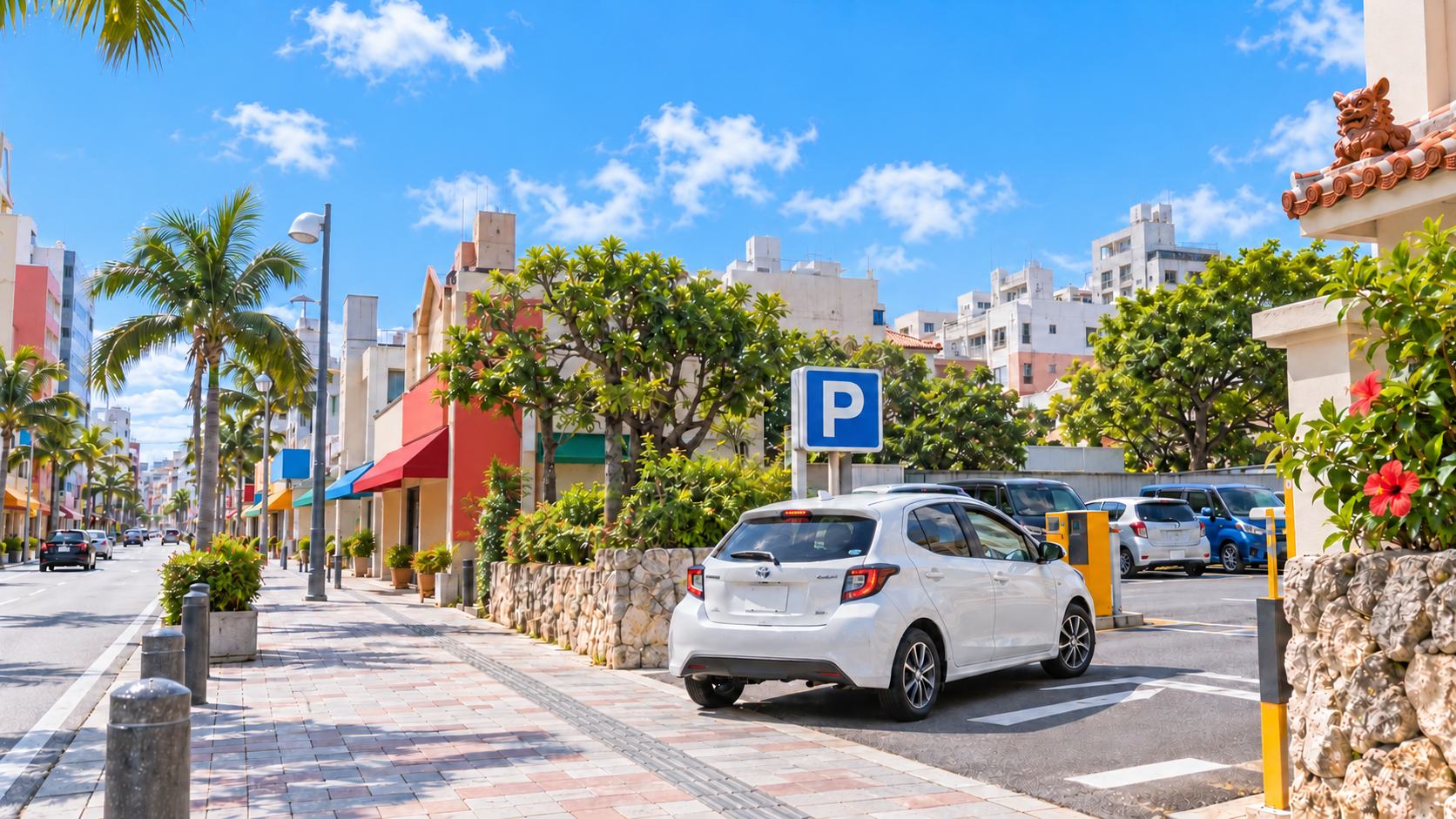
Hello from Wakuwaku Rent-a-Car, Naha Airport branch.
When you rent a car in Okinawa, one thing worth planning ahead is parking in central Naha.
Many sightseeing spots outside the city have free parking, but in Naha you will mostly use paid coin parking or paid hotel parking.
Around Kokusai-dori (International Street), car parks can be full on weekends and during events. Deciding where to park, not just where to go, makes the day easier.
Our honest advice: in Naha, the smartest plan is often a day without the car.
How to compare parking fees in Naha
Compare the total for your stay, not just the hourly rate
Fees around Kokusai-dori vary by location, day, time and space. Do not assume a standard rate; compare the price boards on the day.
For example, “200 JPY per 30 minutes, no daily maximum” comes to 1,200 JPY for 3 hours. “300 JPY per 60 minutes, maximum 900 JPY within 24 hours of entry” comes to 900 JPY for 3 hours. These are made-up examples to show the calculation, not the prices of a real car park.
A few minutes’ walk can change the price
Look beyond the car parks facing Kokusai-dori and include nearby side streets. Prices and availability can differ even close by.
Decide which part of Kokusai-dori you want to walk, and include the walking distance when you choose. On hot or rainy days, or with small children, an easy walk can matter more than the lowest price.
Always check the maximum charge
For a long stay, look for car parks with a maximum charge. But “24 hours from entry”, “until midnight on the same day” and “overnight only” are different. Also check whether the maximum applies repeatedly, and whether some spaces or days are excluded.
“Just one hour” often turns into three hours on holiday. Make a habit of reading the maximum charge on the sign when you enter.
Use parking linked to shops
If you plan to shop or eat, check for partner-parking discounts. Some facilities give a parking ticket when you spend over a set amount.
Check which shops, how much you need to spend and which car park it applies to. Do not use customer-only parking for other purposes.
Bookable parking
Another option is a parking reservation service, which lets you secure a space in advance so you do not have to worry about full car parks.
It is especially useful on weekends and rainy days, when car parks get busy. Some reservation services are in Japanese only.
What to check when choosing a hotel
Parking may cost extra
Hotel parking fees depend on the room plan, vehicle size and length of stay. Compare the room price and the parking fee together.
- Conditions differ by hotel: free, paid or no parking
- Spaces are limited, and when full you may be sent to a nearby car park
- Some hotels require a parking reservation
Check when you book
When you book a hotel, check four things: whether there is parking, the fee, whether you need to reserve, and what happens when it is full.
The last one matters most. If you are told to “use a nearby coin parking”, that adds cost and effort.
Staying outside Naha
You can also look at hotels in Tomigusuku, Urasoe or central Okinawa. Parking is not always free outside the city, so compare the parking conditions together with where you are going next.
If dinners and evening walks in Naha matter most, stay in the city. If you will mainly drive, stay outside. Choose by your travel style.
Parking for Shurijo Castle
Shurijo Castle Park has an underground car park at Suimuikan. Since April 1, 2026, a small car pays 500 JPY for the first 60 minutes, 250 JPY for each further 30 minutes, up to a maximum of 1,000 JPY. The park asks visitors to keep their stay to 3 hours or less.
Checked on November 28, 2026: official notice on parking fees (Japanese).
When it is full you will need a private car park nearby, so arrive early during cherry-blossom season and holidays.
Since November 23, 2026, the inside of the Seiden (main hall) is open to visitors. Viewing requires a timed advance reservation, and the admission fees for the paid area were revised on the same day. Check the latest booking information before you go: official ticket guide.
A different idea: a day without the car
This is the part we most want to share.
Central Naha is easier without a car
Some areas, such as around Kokusai-dori, are easy to explore by Yui Rail (monorail) and on foot. Depending on where you go, buses and taxis are also worth considering.
- Kokusai-dori, Makishi Public Market, Tsuboya Yachimun Street: within walking distance
- Shurijo Castle: walkable from Yui Rail Shuri Station
- Okinawa Prefectural Museum & Art Museum: walk from Omoromachi Station
Central Naha also has rush-hour traffic, bus-lane rules, the Sunday closure of Kokusai-dori and parking fees — all against the car.
Split your trip into “out-of-town days” and “Naha days”
Use the car on days you go further, such as to Churaumi Aquarium or southern Okinawa. On days you walk around Naha, leave the car in the hotel car park.
You avoid parking again and again in the city. Note that this does not necessarily make hotel parking or the rental cheaper. Also check whether you can take the car out and back in during your stay.
Especially for evenings out
Dinner on Kokusai-dori with a drink? Then the car is only in the way.
Japan has very strict drink-driving laws. If you plan to drink any alcohol, leave the car behind from the start, and decide how you will get back before you go out.
Driving in Naha: things to know
Bus-lane rules
On weekday mornings and evenings, bus-lane rules apply on some roads and lanes. The Okinawa Prefectural Police map shows 7:30–9:00 in the morning and 17:30–19:00 in the evening. Check the road, direction and signs on site. On bus-only roads such as Kokusai-dori, ordinary cars may not enter in the restricted direction.
The police also say the rules do not apply on weekends and holidays, January 2 and 3, or when bus services are suspended: Okinawa Prefectural Police bus-lane information (Japanese).
If only the left lane next to the pavement is empty in a traffic jam, suspect a bus lane first.
Kokusai-dori is closed to cars on Sundays
When the Sunday “transit mall” is held, part of Kokusai-dori is closed to ordinary vehicles. It usually runs from 12:00 to 18:00, but times and sections can change with events and weather, so check the traffic information on the day: Kokusai-dori transit mall information.
Even if your navigation sends you onto Kokusai-dori, you cannot enter during these hours.
Park and ride
To avoid traffic in central Naha, you can park at a station outside the city and take the monorail in, for example at Tedako-Uranishi Station, the last stop on the Yui Rail.
Add up the parking fee and the return monorail fares and compare, depending on how many of you there are and where you are going. Station car parks can also be full or restricted, so check before you go.
Where to park, by situation
2–3 hours on Kokusai-dori
Park at a coin parking a little further away and walk. Even better if it has a maximum charge.
Staying in a Naha hotel and leaving the next morning
Secure hotel parking. Check whether there is parking and how much it costs when you book.
Dinner in Naha, then a hotel outside the city
For a short stop, compare the hourly fees. Also check the cost if your plans run longer.
A whole day in Naha
Leave the car and get around by Yui Rail and on foot. This is the most comfortable way.
Planning to drink in Naha
Do not take the car out at all. Leaving it behind is the surest option.
FAQ
Q. Is there free parking on Kokusai-dori?
It is easier to plan around paid coin parking than to count on free parking. If you use a shopping facility, check whether it offers a parking discount when you spend a certain amount.
Q. How much does parking cost?
It depends on the place and time. Check not only the hourly rate but also when, on which days and how often the maximum charge applies, and compare for the time you plan to stay.
Q. Is hotel parking free?
It depends on the hotel: free, paid or none. When you book, check the number of spaces, height limits, whether you need to reserve and what happens when it is full.
Q. Do I need a rental car in Naha?
For walking around Kokusai-dori, the monorail and walking are usually enough. On days you visit several places outside the city, a rental car is convenient. Choose day by day, including buses and tours.
Q. Should I worry about car break-ins?
Wherever you park, do not leave valuables in the car. At tourist car parks in particular, keep bags out of sight.
Summary: in Naha, keep the option of not driving
Planning is easier if you use the car differently for drives outside the city and for walking around Naha.
Walk on your Naha days, and make full use of the car on your out-of-town days. This simple switch makes the whole trip easier.
Book on our official website and we’ll meet you at Naha Airport and take you to our branch, where you’ll collect your rental car. We’ll email you the meeting details. Before you book, please check the documents you need to drive in Japan on our rental terms page.
- If you will also drive in central Naha: an easy-to-handle compact car
- For families and groups driving mainly outside the city: a 7- or 8-seat minivan
Planning a drive north? See also: Naha to Churaumi Aquarium by car: expressway or local road?.
Just choose your dates to see which cars are available and how much they cost.
Choose your dates and check prices
Information is correct at the time of writing. Parking fees, opening hours and traffic rules may change, so please check the signs on site and the latest official information before you go.


 はじめての方へ
 予約する
 空車をさがす