
 ご利用方法について
 車種について
 観光ガイド
 よくあるご質問
 お問い合わせ
Okinawa in Typhoon Season: How to Prepare and What to Do on the Day
2026.11.28
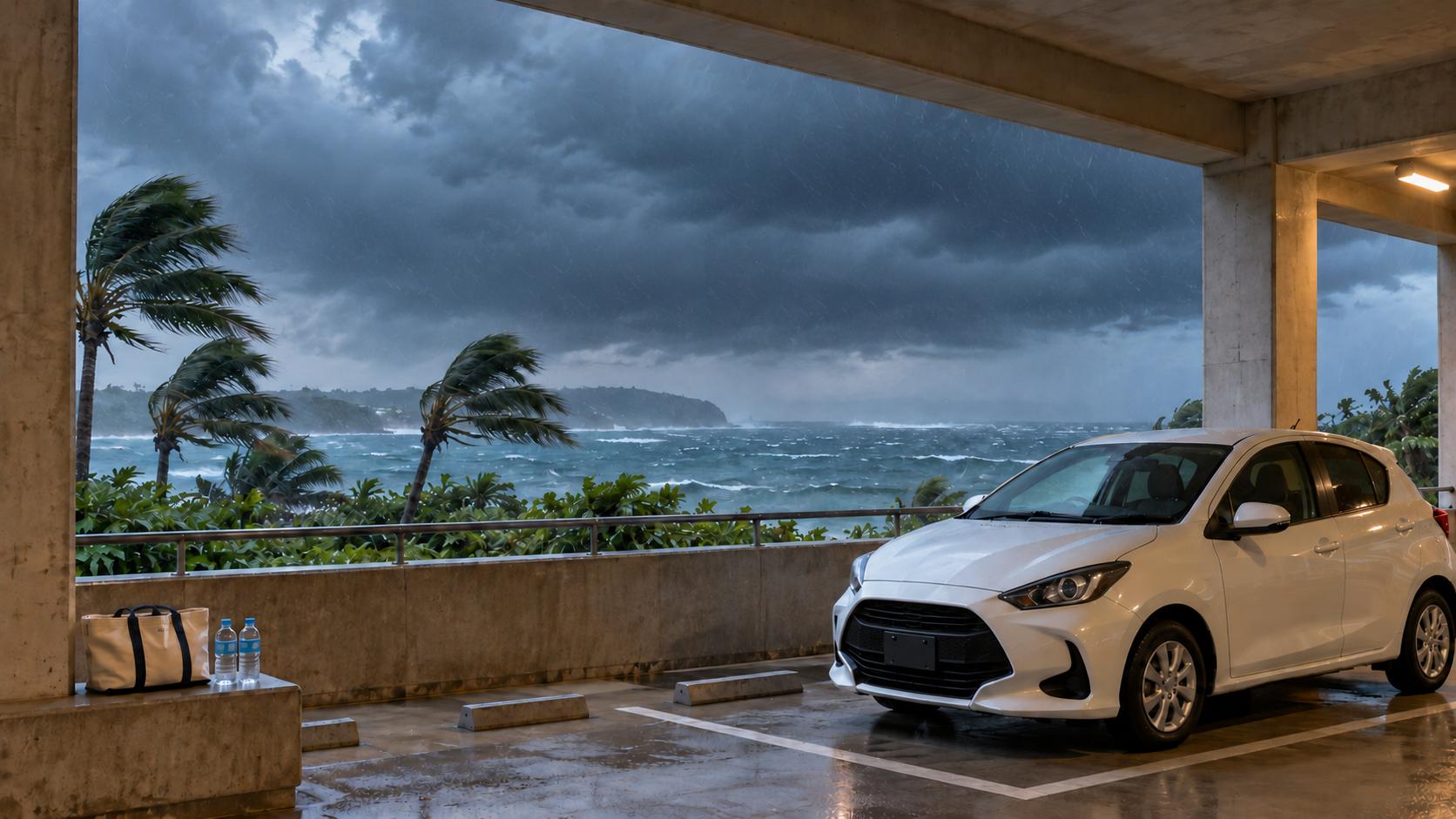
Hello from Wakuwaku Rent-a-Car, Naha Airport branch.
After booking a summer trip to Okinawa, many people start watching the weather forecast and wondering: “What happens if a typhoon comes?”
How a typhoon affects you depends on its track, its strength and where you are staying. As a visitor you may not know the area well, so it is important to adjust your plans early and prepare so that you do not need to travel.
The key is to know in advance what may stop and what you should do. This guide sets out how to prepare and how to act on the day.
First: prepare before the wind picks up
When a typhoon approaches, watch out not only for strong wind but also heavy rain, storm surge and high waves. Even if the centre of the forecast is some distance away, your area may still be affected.
The wind can also return after the typhoon has passed. Do not decide it is safe just because it has gone by; keep checking the weather information and your surroundings.
Check warnings and service suspensions separately
Warnings from the Japan Meteorological Agency (JMA) call for caution about possible disasters. Transport and facilities do not all stop at the moment a warning is issued.
- Yui Rail (monorail) and buses: check each operator’s suspension times and service status
- Taxis: they may be unavailable even when operating, so do not rely on them as your last way home
- Sightseeing spots and shops: check each one for temporary closures or shorter hours
- Flights, ferries and marine tours: check the operator’s decision, not only whether there is a warning
Travel can become dangerous even before a warning is issued. Get back to your accommodation before you get stuck.
JMA Okinawa disaster-prevention information (Japanese) / Yui Rail official site. The Japan Tourism Agency’s free “Safety tips” app sends severe-weather alerts and evacuation information in English and other languages. Keep checking JMA, local authority and transport information as well.
Services restart one by one once the storm area has passed and safety has been checked, but when they restart depends on the situation.
When a typhoon is approaching: what to do during your stay
1. Move to your accommodation before warnings are issued
This comes first. Once the wind and rain get stronger, it may not be safe to travel.
Check the weather and transport information and move to safe accommodation before the wind and rain get strong. If the local authority issues evacuation instructions, follow them.
2. Shop early
As a typhoon approaches, food can sell out and shops may close early.
Buy drinks and snacks and charge your power bank before the wind gets strong.
3. Prepare for power and water cuts
A strong typhoon can cause power cuts and water outages.
- Fully charge your phone and power bank
- Keep drinking water
- Some hotels have emergency supplies; if you are worried, ask in advance
4. Decide where you will get information
- Your airline’s official website (cancellations and flights eligible for changes)
- Naha Airport’s official website
- Yui Rail and bus service status
- JMA warnings and advisories
Flights may show “checking the weather” and not be decided until the last minute. Stay calm and check for updates regularly.
What to do with your rental car
This is our area of expertise.
Do not drive when a storm warning is in force
We ask this very strongly.
- Strong wind pushes the car sideways, especially on bridges and coastal roads
- Flying objects such as signs and branches can come at you
- Okinawa’s roads become very slippery in the rain
- Fallen trees can block roads, and bridges may be closed
Gusts and heavy rain can be dangerous whatever your driving experience. Do not force a journey, and follow local evacuation information.
Where you park matters
Few people know that where you park can change the damage.
Places to avoid
- Under trees: branches can break and fall
- Next to utility poles or signs: they may fall over
- Open car parks by the sea: salty wind and flying objects
- Low places that flood easily
Better places
- Places your hotel or the car-park manager recommends, with less risk of flooding or flying objects
- Even indoors, avoid basements and low areas that may flood
Being under a building does not always mean it is safe. Wind direction can change and flooding can happen, so follow the manager’s advice. Do not go outside just to move the car once the weather is already rough.
Also, in strong wind, neighbouring cars’ doors can blow open and hit your car. Leave space when you park.
Take care opening doors
Wind can catch a car door and slam it into a neighbouring car or wall. Finish moving while the wind is still light, and do not get in or out when the wind makes it dangerous.
Return times and our opening hours
When a typhoon approaches, rental companies may shorten opening hours or change how returns work.
If it may be unsafe to return the car on time, email us in English at wakuwakunaha@gmail.com before your scheduled return whenever possible. Include your booking number, scheduled return time, the date and time you would like, and why you cannot return safely. Do not drive in dangerous conditions.
An extension is subject to availability and is only confirmed once we approve it and the extension charge has been paid in advance. No reply does not mean approval. Return arrangements and any charges follow your rental agreement and our instructions. We cannot promise an immediate or 24-hour response.
If your flight is cancelled
If a typhoon hits on your last day
- Check official information from your airline and the airport: cancellations, flights eligible for changes and terminal opening hours
- Change or refund your ticket through the airline or travel agent. Do not head to the airport in bad weather just because there is no update yet
- Ask early about an extra night at your hotel and about returning or extending your rental car
- Only travel once you have a safe route and transport
Flights can become eligible for changes on the day before or on the day itself. Start checking as soon as a typhoon appears in the forecast.
Rooms go fast
If you only start looking for a room after your flight is cancelled, hotels may already be full. Once the typhoon’s track is clearer, keep the possibility of an extra night in mind.
Extending your rental car
Your rental is not extended automatically when your flight is cancelled. If you need to change the return date, it must be arranged separately.
Please email us first. We will discuss an extension, but the car may already be booked by someone else from the next day, so the earlier you contact us, the more options we have. The extension is only confirmed once we approve it and you have paid the extension charge in advance.
Before you book: about cancellations
Can I cancel if a typhoon may come?
Cancellations, including those because of a typhoon or a cancelled flight, follow the booking channel, your booking conditions and our rental terms. In this guide we cannot promise that a typhoon forecast alone makes cancellation free, or that a fee always applies. See the cancellation charges on our rental terms page.
If you booked on our website, email us in English at wakuwakunaha@gmail.com. For bookings made through a travel agency or another website, request the cancellation or change through that provider. Our opening hours are 9:00–19:00 Japan time; cancellation requests received outside these hours are treated as received on the next business day. A typhoon forecast or flight cancellation does not automatically waive the charge.
If we are unable to provide the car ourselves, this is not treated as an ordinary customer cancellation and is handled under the individual conditions. Changing a booking before pickup has a separate rule (by 19:00 Japan time the day before pickup) and does not apply to cancellations or to extensions after pickup. Having your booking number, rental date and flight details ready helps. If you cannot pick up the car as planned, please let us know in advance.
Flight, hotel and activity cancellation rules depend on each provider. Remember to review your whole trip, not just the car.
Should I avoid typhoon season?
It is a difficult question. As a fact, August and September are the months when typhoons come closest most often.
The effects may pass quickly or last for days. Do not assume you can always restart sightseeing after one day. Check whether your bookings allow date changes, and who to contact for an extra night.
Rain and wind, but no storm warning yet
This is the hardest situation to judge: wind and rain, but no warning.
No warning does not mean it is safe to go out. If you are advised to stay inside, or roads are dangerous, stay at your accommodation. Only if you can travel safely and the place is open, indoor sightseeing is an option.
- Okinawa World (Gyokusendo Cave): indoor sections; check the route and opening status
- Churaumi Aquarium: an indoor facility
- DMM Kariyushi Aquarium: inside a shopping complex; check the route from parking and opening status
- Large shopping malls: for example AEON Mall Okinawa Rycom
Each facility decides on closures separately. Check its official information and road conditions before you go, and if you have any doubt, cancel the plan.
If you do go out, keep stops to a minimum and make sure you have a route and time to get back to your accommodation.
FAQ
Q. Is it OK to drive the rental car during a typhoon?
Never drive while a storm warning is in force. Even before a warning, on windy days avoid bridges and coastal roads and keep driving to a minimum.
Q. What happens if the car is damaged by a typhoon?
In a traffic accident, make sure everyone is safe and help anyone who is injured. Call 119 for injuries or fire. Report every accident to the police (110), even if no one is hurt, then contact us.
If the car is damaged by wind or water while parked, stay safe and follow our instructions, using the accident and breakdown contact on your rental agreement. Our English email is for general enquiries and does not replace emergency calls.
Whether typhoon damage is covered depends on the cause, your rental conditions and the required procedures; we cannot promise it in advance. CDW does not cover the Non-Operation Charge (NOC); the NOC waiver is a separate option. Do not arrange repairs yourself. See protection details on our rental terms page.
Q. Is everything closed on a typhoon day?
Many places may close or shorten their hours. Check each one, including facilities in your hotel, and be ready to stay at your accommodation.
Q. Can I go sightseeing as soon as the typhoon passes?
Return winds, flooding, fallen objects and high waves may remain. Do not judge only by the warning being lifted; wait for roads and facilities to confirm they are safe and open. At beaches, follow the local swimming rules.
Q. How many days ahead can I tell if a typhoon will affect me?
Track forecasts are usually available several days ahead, but typhoons near Okinawa often change course. It is common for the situation to change the day before or on the day.
Summary: prepare early and put safety before plans
In typhoon season, the most dangerous thing is acting without knowing what to expect.
Transport and opening hours may change. Move to safe accommodation before the wind and rain get strong, and secure water, food and a way to stay in contact. Do not force your itinerary — safety comes first.
Even after the weather improves, wait for roads and facilities to announce they have reopened.
If a typhoon changes your plans, please email us in English at wakuwakunaha@gmail.com. We will advise on returns and extensions after checking safety and other bookings; an extension is confirmed only when we approve it and the extension charge has been paid in advance. Our phone line is in Japanese only, and we cannot promise an immediate or 24-hour response.
Just choose your dates to see which cars are available and how much they cost.
Choose your dates and check prices
Information is correct at the time of writing. How to respond to weather, transport services and opening hours depend on the situation at the time. Always check the latest official information and put safety first.


 はじめての方へ
 予約する
 空車をさがす